

Why Texas Is One of the Best States to Open an
Assisted Living Facility in 2026
Texas is experiencing a demographic shift that creates one of the strongest business cases in the country for new Assisted Living Facilities. The state’s 65-and-older population is projected to nearly double by 2050, and demand for quality senior care already outpaces supply in dozens of metro and rural markets.
If you’ve been researching how to start an assisted living facility in Texas, the opportunity has never been more compelling—but the licensing process can feel overwhelming if you don’t have a clear roadmap.
This guide walks you through every step of the process, from forming your business entity and completing your ALF manager certification through passing your HHSC surveys and admitting your first resident.
We’ve included actual timelines, current 2026 costs, and the regulatory checkpoints you’ll need to clear so you can plan with confidence.
Whether you’re converting a single-family home into a small residential care home or developing a purpose-built community for 50 or more residents, the licensing pathway in Texas follows the same core sequence. Understanding it from the beginning will save you months of delays and thousands of dollars in avoidable mistakes.
Who This Guide Is For
Entrepreneurs exploring assisted living as a business opportunity, healthcare professionals transitioning to facility ownership, real estate investors diversifying into senior housing, and family members who want to create better care options in their community.
Understanding Texas Assisted Living Facility
License Types
Before you submit a single form, you need to understand the licensing framework. All assisted living facilities in Texas are licensed and regulated by the Texas Health and Human Services Commission (HHSC) under the Texas Administrative Code (TAC), Title 26, Chapter 553, and authorized by the Texas Health and Safety Code, Chapter 247. These two documents are the regulatory foundation for every ALF in the state.
Type A vs. Type B Assisted Living Facility License in Texas
Texas classifies assisted living facilities by both license type and facility size. Getting this decision right at the outset is critical because it affects your building requirements, staffing model, the residents you can serve, and your overall business plan.
| Category | Type A Facility | Type B Facility |
|---|---|---|
| Resident Evacuation |
Residents can evacuate independently and follow directions during emergencies | Residents may require staff assistance to evacuate and may not follow emergency directions independently |
| Overnight Staffing |
Staff must be immediately available but are not required to be awake (small facilities) | Staff must be immediately available AND awake at all times, regardless of facility size |
| Memory Care | Cannot operate a certified Alzheimer’s/dementia unit | Can operate a certified Alzheimer’s/dementia unit (additional $300 certification fee) |
| Ideal For | Higher-functioning seniors who need assistance with daily living but are physically mobile and cognitively capable | Seniors with moderate to advanced care needs, including those with dementia or limited mobility |
Texas also classifies facilities by size: a small ALF serves 16 or fewer residents, while a large ALF serves 17 or more. Large facilities face additional staffing requirements, including the need for two staff members to be immediately available whenever residents are present.
Important: Type C Licenses
Texas formerly issued Type C licenses for four-bed adult foster care homes. HHSC no longer issues new Type C licenses—only renewals for existing holders. If you’re planning a four-bed home, you’ll need a Type A or Type B license.
What You Need Before You Apply for a Texas
Assisted Living License
The HHSC application process is thorough and sequential. Missing a single required element can delay your application by 30 to 60 days—or result in outright denial.
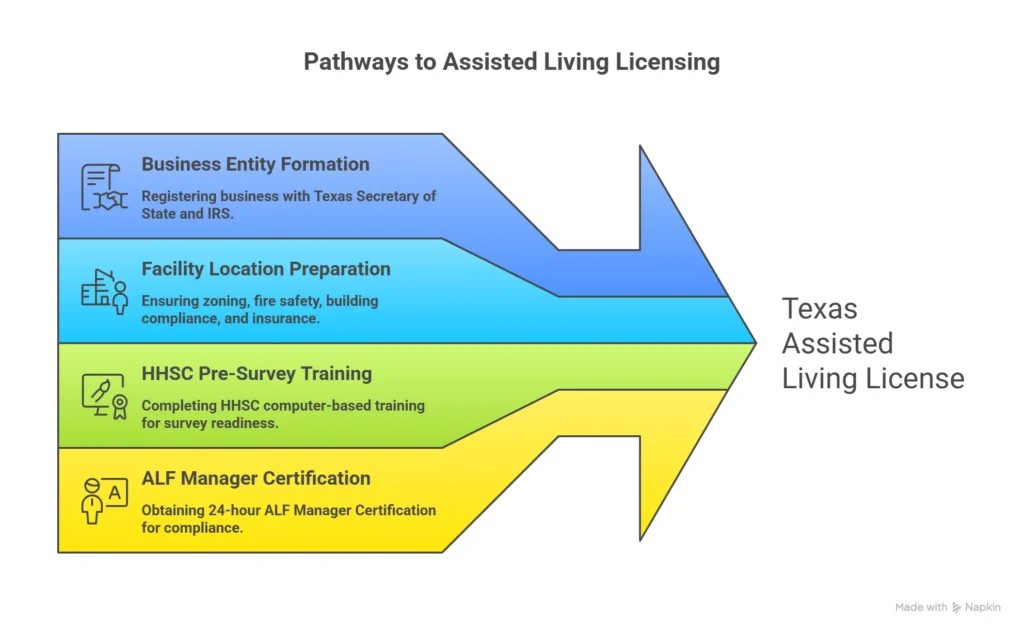
Step 1: Form Your Business Entity
Register your business with the Texas Secretary of State. Most operators choose an LLC or corporation structure for liability protection. You’ll also need a federal Employer Identification Number (EIN) from the IRS and a Texas state tax ID from the Comptroller’s office. Consult with a business attorney and CPA who understand healthcare regulations to select the optimal structure for your situation.
Step 2: Secure and Prepare Your Facility Location
Your property must meet specific requirements before HHSC will even schedule a survey. The critical items include the following.
Zoning approval: Verify with your city or county that the property is zoned for assisted living use. Zoning requirements vary significantly by municipality in Texas. Some cities require a Conditional Use Permit (CUP) or Special Use Permit for residential care facilities—a process that can take 60 to 90 days on its own. Start this early.
Fire Marshal inspection: You must submit a current, approved fire marshal inspection to HHSC. Your building must comply with the Life Safety Code standards referenced in TAC Chapter 553, Subchapter D. Work with your local fire authority well before your application to identify and resolve any deficiencies.
Building compliance: The facility must meet HHSC’s physical plant standards, including requirements for bedroom sizes, bathroom accessibility, kitchen and dining areas, emergency lighting, and ADA accessibility. If you’re converting a residential property, anticipate renovation costs for widening doorways, adding grab bars, upgrading fire suppression systems, and ensuring adequate egress routes.
Insurance: HHSC requires proof of general liability insurance and professional liability (malpractice) coverage. Most carriers also recommend property insurance and workers’ compensation coverage. Budget $8,000 to $25,000 annually depending on your facility size and coverage levels.
Step 3: Complete the HHSC Pre-Survey Computer-Based Training
This is a requirement that catches many first-time applicants off guard. HHSC requires all new ALF applicants to complete a pre-survey computer-based training (CBT) before submitting their license application. You must submit a copy of the certificate of completion with your application. This training covers the fundamentals of Texas ALF regulations and survey expectations. It is separate from the 24-hour ALF Manager Certification course.
Step 4: Complete Your ALF Manager Certification in Texas
Every licensed assisted living facility in Texas must designate a manager who has completed a 24-hour ALF Manager Certification course. This requirement is defined in TAC §553.253(a)(1)(A). The course must cover topics including resident characteristics and needs, basic principles of assisted living management, federal and state laws, emergency preparedness, and resident rights. HHSC maintains a list of approved ALF Manager course providers on their website.
HHSC does not review course curriculum or endorse specific providers, but the training must align with the requirements outlined in Chapter 553. Academy of Senior Living’s Texas ALF Manager Certification program covers all required competencies in a flexible online format designed for working professionals. Our curriculum goes beyond minimum compliance to prepare you for real-world facility operations from day one.
Continuing Education Requirement
After your initial 24-hour certification, Texas requires all ALF managers to complete 12 hours of continuing education annually. These CEUs must include at least two of the following categories: resident and provider rights, abuse and neglect prevention, confidentiality, emergency preparedness, medication management, cognitive impairment care, or management practices. The first-year certification satisfies this requirement for year one.